
Microauthenfy for packaging: security and design integrated at the mould level
Reading time: 8 minutes
When brand protection becomes part of the design
Packaging is no longer just a container. In premium and mass‑premium markets—cosmetics and perfumery being one of the clearest examples—it has become a brand statement, a trust anchor and, increasingly, a vulnerability. Counterfeiting, parallel markets and unauthorized refilling are no longer marginal problems; they directly affect brand equity, consumer safety and regulatory compliance.
Most anti‑counterfeiting solutions used today are add‑ons: labels, holograms, inks, QR codes or secondary operations added after moulding. They work—up to a point—but they also introduce extra cost, extra process steps, and often an aesthetic compromise.
Microauthenfy was developed to answer a simple but powerful question:
What if authentication was not added to the product, but built into it?
In this article we present a real case study in cosmetic packaging: a plastic cosmetic cream cap whose mould was engraved with Microauthenfy technology, injected in standard production conditions, and designed to deliver both robust anti‑counterfeiting and a strong visual “wow effect”—with no additional production steps.
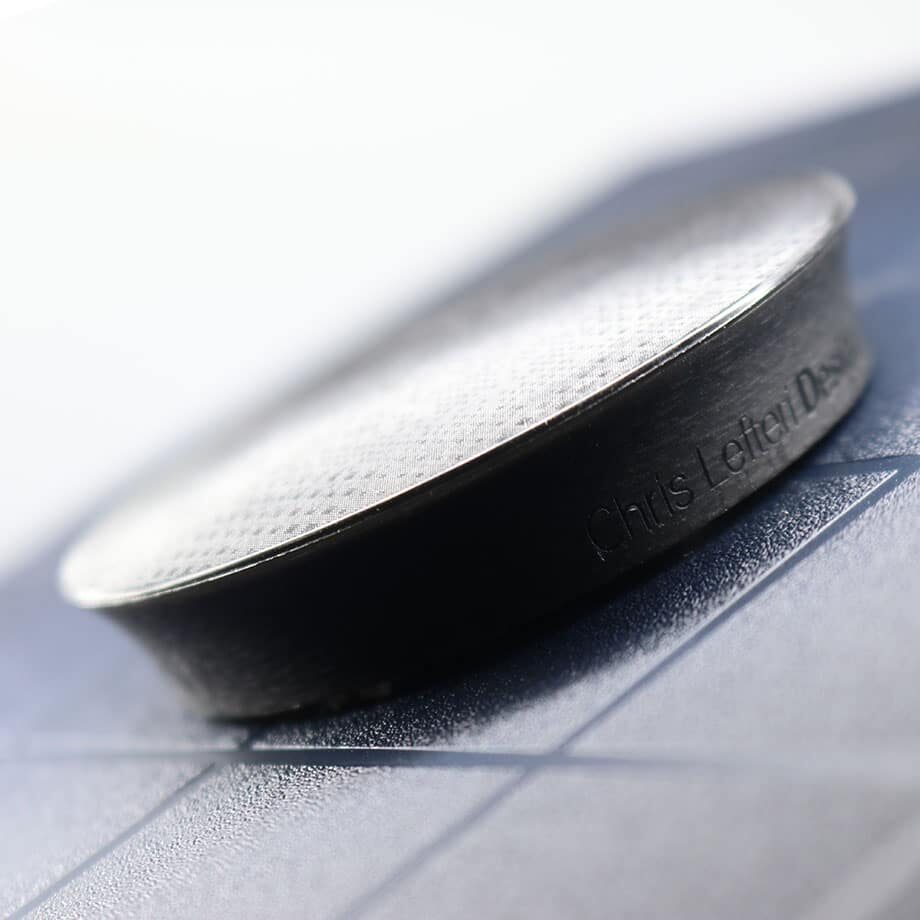
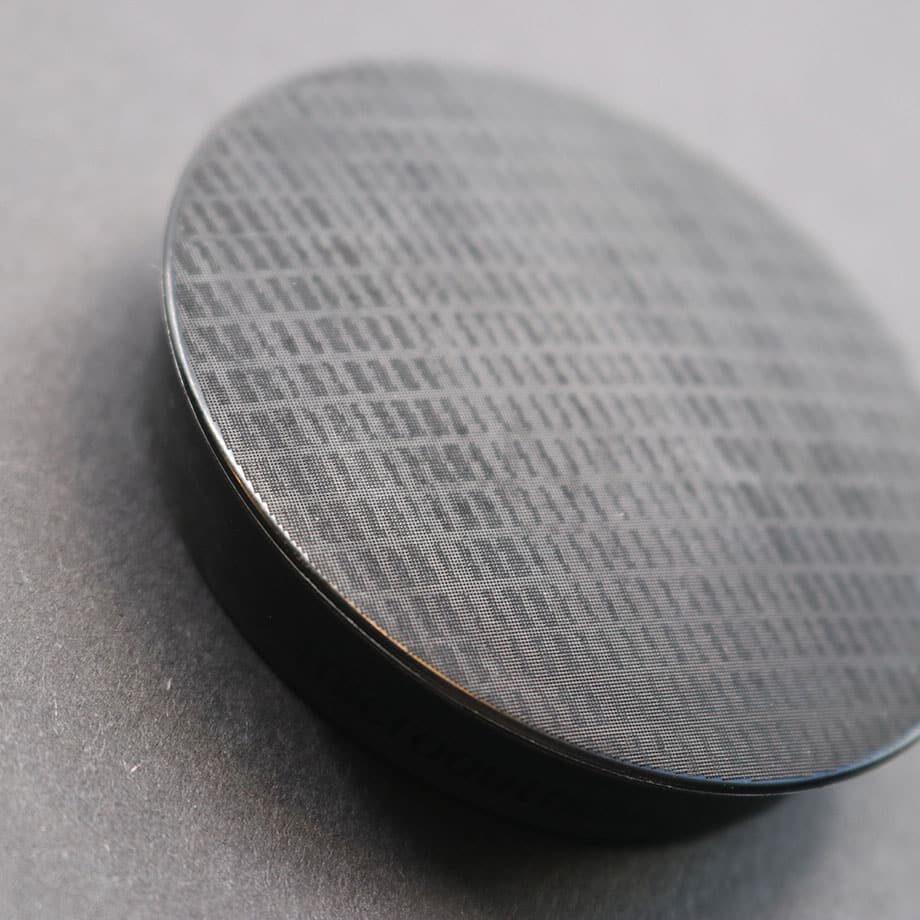
What is Microauthenfy?
Microauthenfy is an integrated anti‑counterfeiting solution based on ultra‑precise laser micro‑engraving of production moulds.
Instead of marking each individual part, Microauthenfy engraves non‑replicable micro‑features directly into the mould surface. These micro‑structures are faithfully replicated during standard injection moulding, becoming an intrinsic part of every produced component.
Key characteristics:
- Sustainable. No extra processes: no labels, no inks, no post‑processing
- No impact on manufacturing and production. No special requirements
- Instant verification: visible to the naked eye
- Advanced security: extremely difficult to copy, even with advanced tooling
- Compatible with high‑volume production
The result is a security feature that behaves like a design feature—because, in practice, it is one.
Case study: a cosmetic cream cap
The challenge
Cosmetic packaging faces a dual challenge:
- Brand protection against counterfeit products and unauthorized refilling
- Visual differentiation in an increasingly saturated market
Our objective with this project was to prove that Microauthenfy can address both—simultaneously—without changing the industrial process.
The project ecosystem
This case study is the result of a collaborative, real‑world industrial workflow:
- Microrelleus – Microauthenfy technology development and engraving of the injection mould
- Chris Lefteri Design Studio – Design of three distinct Microauthenfy visual patterns, each one with 4 different images
- Motecsa – Injection moulding of the cosmetic caps
The goal was not a lab prototype, but a fully industrial example, representative of what brands could implement today.
From design to mould: where security is born
Designing micro‑features, not graphics
Unlike surface decoration, Microauthenfy designs are not flat images. They are three‑dimensional micro‑geometries, engineered to interact with light and material flow at a microscopic scale. This process is carried out using our proprietary algorithm; from the customer, we only require four images in standard image formats or vector files.
For this project, three different designs were created by Chris Lefteri Studio, each exploring a different visual language:
- Sample one: patterns transition through varying scales of triangular geometrics inspired by fractals found in nature (photos of the same part, rotated by 90 degrees).

- Sample two: inspired by Fibonacci spirals in nature linear patterns radiate outward before transitioning in scale (photos of the same part, rotated by 90 degrees).

- Sample three: micro patterns shift between states exploring empty space before revealing the sample name (photos of the same part, rotated by 90 degrees).

These designs were then translated into micro‑structured geometries in Microrelleus, suitable for mould engraving and mass replication.
Ultra-precise laser engraving of the mould
The injection mould for the cosmetic cap was engraved using 5‑axis ultra precise laser technology.
This step is critical, it allows:
- Feature sizes and depths not achievable with conventional engraving
- Extremely sharp edges with no thermal damage
- Absolute control of micro‑geometry orientation, even on curved surfaces
Once engraved, the mould becomes the master security tool. Every injected part automatically carries the Microauthenfy signature.
In the following images, the engraved mould insert with Fibonacci spirals is shown. It is the same insert, rotated by 90 degrees.

Injection moulding: standard process, extraordinary result
The engraved mould was installed at Motecsa, where the cosmetic caps were injected using standard plastic injection moulding parameters.
No adjustments were required:
- No special materials
- No changes on production
- No additional quality steps
The Microauthenfy features replicated naturally during moulding, proving a key point:
If a solution disrupts production, it won’t scale. Microauthenfy was designed to scale from day one.

The result: security with a wow effect
Anti‑counterfeiting by design
From a security perspective, the injected caps show:
- Micro‑features that are extremely difficult to measure, reverse‑engineer or replicate
- A dependency on the original mould geometry, not just the visible surface
- A level of complexity that makes copying economically and technically extremely difficult
Unlike visual markings that can be photographed and reproduced, Microauthenfy relies on manufacturing know‑how, not visual appearance alone.
Visual differentiation
At the same time, the Microauthenfy designs deliver a clear perceived value:
- Subtle premium appearance
- Dynamic interaction with light
- A discovery effect: the design reveals itself progressively
This dual nature—security plus aesthetics—is where Microauthenfy truly differentiates itself.
Triangular design sample. Photos of the same part, rotated by 90 degrees:

Fibonacci spirals design sample. Photos of the same part, rotated by 90 degrees:

Micro patterns design sample. Photos of the same part, rotated by 90 degrees:

Designer perspective: a conversation with Chris Lefteri Studio
To explore the design dimension of Microauthenfy, we spoke with Chris Lefteri, internationally recognized for its work on materials, finishes, and future design languages.
- From a designer’s perspective, what does Microauthenfy enable that traditional surface decoration cannot?
The surface is everything! It marks the point where the object meets the external world. It’s the boundary — like a skin. After seeing a colour, the surface is where the consumer story starts to unfold: the first physical interaction. It offers a truly unique creative opportunity to control that surface in a way that traditionally has not been possible. - How does working at the mold and micro‑structure level change the way you think about packaging aesthetics?
Working at this level of precision detail gives designers an unparalleled ability to explore the surface in terms of function, haptics, and aesthetics, in a way that removes the need for secondary processes such as painting. Obviously, this is preferable from both a cost and environmental point of view. Microauthenfy’s ability to control the micro-structure adds another design dimension, allowing influence not just as a static image, but as something that changes depending on the viewing angle. - Do you see Microauthenfy more as a security feature, a design feature, or a new hybrid category?
For me as a designer, the fact that it is hard to replicate is particularly interesting. It gives brand owners the chance to create effects that are difficult to copy — not just in terms of counterfeiting, but also in offering something truly unique and very premium to their customers. - How do you imagine brands using micro‑structured authentication as part of their visual identity in the future?
The possibilities are endless. From simply using it to create a logo without the need for films or paints, through to creating and applying brand textures and patterns across different products. But it’s not just about replicating a pattern — it’s also about how the product feels and how that feeling is interpreted as an experience for the consumer, which elevates the brand.
This dialogue reinforces a core idea: security does not need to be hidden or purely technical — it can become part of the design language itself.
Why this matters for cosmetic brands
Microauthenfy offers brands a rare combination:
- Security without added complexity
- Design differentiation without added decoration
- Scalability without process changes
- Sustainability by avoiding additional materials and labels
In a market where authenticity, brand trust and visual impact are increasingly intertwined, integrating protection at the mould level represents a strategic shift.
Conclusion: protection built into the product
This cosmetic cap case study demonstrates a fundamental principle:
The most robust anti‑counterfeiting solutions are not added at the end—they are designed at the beginning.
Microauthenfy transforms the injection mould into a security asset and the packaging itself into a carrier of trust, identity and value.
For brands looking to protect, differentiate and elevate their products—without complicating production—this approach opens a new design and industrial paradigm.
If you would like to explore how Microauthenfy can be integrated into your packaging projects, or to see the physical samples from this case study, feel free to contact us.


