
How femtosecond laser is enhancing automotive lighting design and manufacturing
Reading time: 7 minutes
The Miniaturization Trend
In recent years, there has been a clear trend towards miniaturization in the industry. Why? Because smaller means lighter, more efficient, more compact, and more sustainable. However, miniaturization comes with a major challenge: manufacturing precision at microscopic scales in a cost-effective way that ensures feasibility for large-scale production.
Traditional manufacturing technologies—CNC milling, die-sinking EDM, chemical etching—struggle to produce high-quality micro-features, especially on complex 3D surfaces. Nanotechnology processes offer better resolution, but they lack industrial scalability and are not practical for applications like injection moulds.
So, how do we bridge this gap? With femtosecond laser technology.


What is a Femtosecond Laser and Why is it Unique?
A femtosecond laser emits ultra-short pulses (1 fs = 10-15 seconds). These pulses are so short that there are no thermal effects when engraving. In contrast, nanosecond lasers emit short pulses (1 ns = 10-9 seconds), which generate thermal effects during engraving, leading to burrs, uncontrolled shapes, rounding of edges, and poor surface finishing. This makes nanosecond lasers unsuitable for the lighting industry, where high-quality surface finishing, sharp edges, and extreme precision of micro-optics are critical to achieving the photometric values simulated in optical design software for injected parts.

What Do These Ultra-Short Pulses Mean in Practical Terms?
- No burrs, no melting, no heat-affected zones.
- Sharp edges.
- Extreme precision, with features in the micron range.
- Compatible with almost any material.

SHARP EDGES

ABSOLUTELLY
BURR-FREE

HIGH QUALITY
SURFACE FINISHING

EXCELLENT
TOLLERANCES

ENGRAVING OVER ANY MATERIAL
Those characteristics make the femtosecond laser engraving the perfect solution for industries requiring microscopic details while maintaining industrial scalability on mould, such as automotive lighting.
Forget about tool or electrode wear and tear—femtosecond laser processing is highly stable, wear-free, and ensures consistent, reliable results with guaranteed repeatability.

Breaking Manufacturing Barriers
Today, 5-axis femtosecond laser machines allow us to engrave continuous freeform microstructures and textures on 3D surfaces of large and heavy parts, moulds, or tools—something that was impossible with previous technologies.
The process is fully digital, meaning we can apply any pattern to any area, ensuring perfect reproducibility. This is particularly advantageous for mould engraving, where scalability becomes a major benefit: once a microstructure is engraved on a mould, it is replicated in every injected part.

Is It Sustainable?
Femtosecond laser technology is not only about precision; it is also a greener manufacturing solution:
- Low energy consumption: Uses low-power laser sources.
- Zero chemical waste: No acids, solvents, or hazardous residues.
With benefits extending to the injected parts and the system:
- Material reduction: Thanks to new possibilities enabled by micro-optic engraving.
- Increased efficiency: In final injected parts for lighting applications.
- Easy to recycle: Monocomponent materials without the need for added films.
- Material efficiency: Functional textures can reduce the need for coatings or paints, leading to a more sustainable final product.
Femtosecond Laser in the Lighting Industry
The design and functional possibilities are virtually limitless across various industries, particularly in automotive lighting. We can engrave freeform microstructures and micro-optics in production tools or prototypes, achieving smaller details and better tolerances than conventional technologies, opening up new design and functional possibilities.
Some applications of this technology include:
- Spreading or diffusing light with attractive surface patterns.
- Directing light to specific areas
- Engraving almost invisible microstructures for surface light guides or light curtains.
- Creating anti-glare surfaces directly on injected parts by engraving the tool.
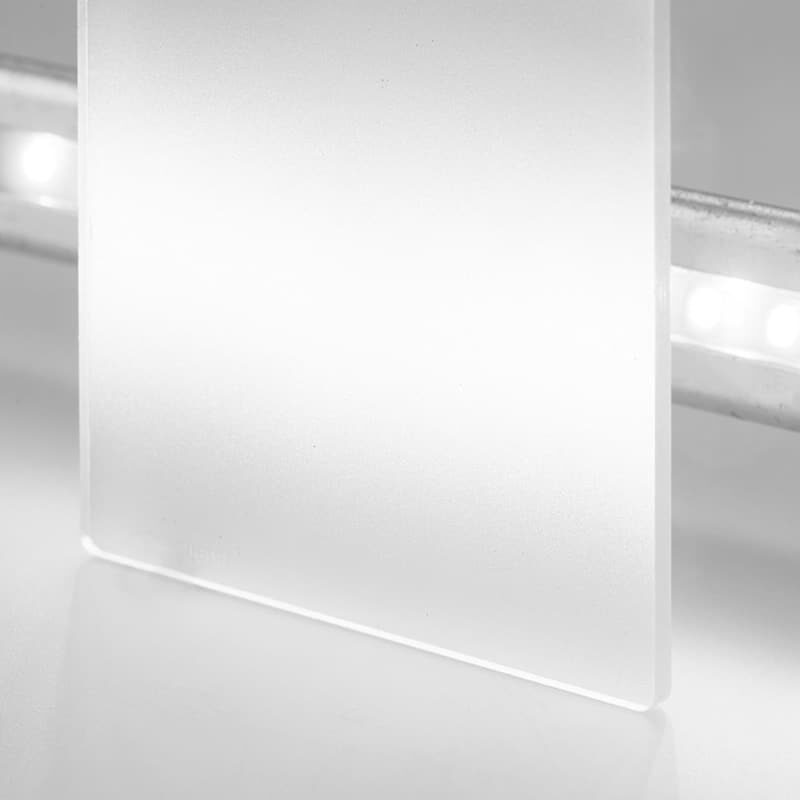
Do you need light diffusion while using transparent material? Controlled diffusion with perfect repeatability is possible thanks to Microscatt® technology—engraved textures on hte mould, a burr-free process that remains independent of the material or conditions of the tool.

Prototyping Advantage
We can also engrave microstructures, micro-optics, and textures—including VDI reference imitations—onto PMMA prototypes using femtosecond laser. This allows customers to evaluate the final injected part’s behavior months before production, with the flexibility to make design changes or refinements without affecting delivery time or incurring costly mould modifications.
Real-World Example: Cupra Formentor and Cupra León
Cupra engineers wanted to evolve from uniform lines to surfaces, enabling three-dimensional optical designs. At Microrelleus, we used femtosecond laser technology to engrave thousands of micro prisms, ensuring homogeneous light distribution from a perpendicularly placed light source—an innovation featured in Cupra's latest tail light design.
The Process is Simple:
- The customer (or Microrelleus optical engineering team) designs the optical concept with micro-optical structures.
- Performance is simulated by optical engineers to ensure the desired lighting effect.
- The mould is engraved (or a prototype is manufactured before).
- The final part is injected and validated.
Below, you can see images of the process and the final results on production vehicles - Cupra Formentor and Cupra León.

Want to explore more real-world examples?
Visit: discover cars on the road
In some of them we used femtosecond laser to engrave micro-optics directly onto production tools. In others, we applied our Microscatt® technology to achieve controlled light diffusion and eliminate hot spots. In some projects we even combined both techniques to optimize optical performance.
Conclusion: A True Industrial Revolution
Femtosecond laser technology is not just an evolution—it’s a revolution. It represents the natural progression from conventional technologies to the micro-scale, enabling manufacturers to achieve levels of precision, scalability, and functionality that were previously unattainable—with consistent, repeatable results. Whether applied to molds, tools, or final parts, this technology is reshaping the boundaries of what is possible in lighting manufacturing.
Miniaturization is the future, and femtosecond laser is the key to unlocking its full potential—reliably and efficiently.


