
How material and color influence Microauthenfy® visibility in injection-moulded parts
Reading time: 7 minutes
1. Introduction: Material choice matters
Microauthenfy® introduces a new class of integrated anti-counterfeiting, embedding a dynamic optical mark directly into the injection mold. Because the mark is physically engraved onto the tool, every part molded from that tool is inherently authentic—no labels, inks, additives, or post-processing required.
This makes Microauthenfy compatible with virtually any injection-molded plastic product, including but not limited to:
- Premium and mass-market packaging
- Footwear components
- Caps and closures
- Consumer goods and electronics
- Sports and lifestyle products
- Automotive components
- Wearables and accessories
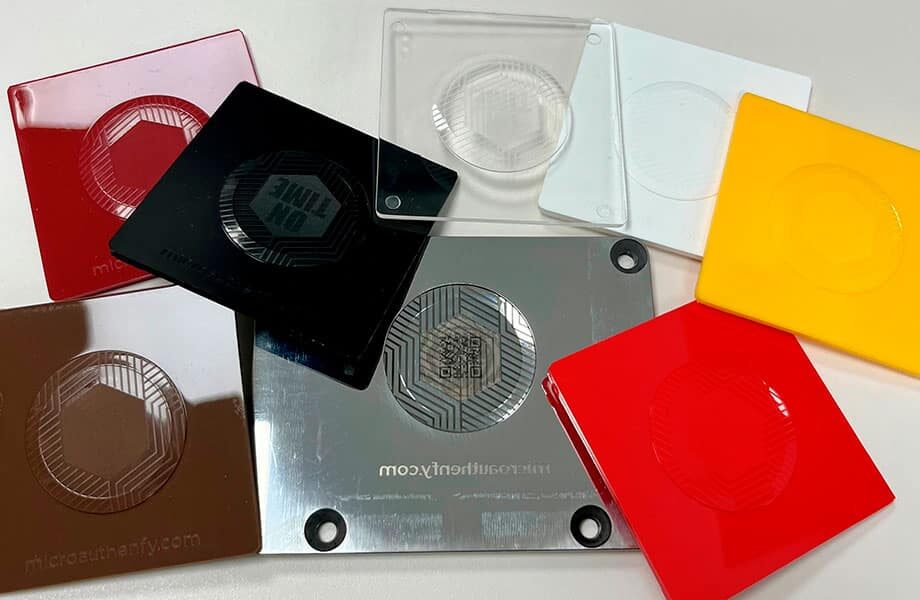
Each of these markets uses a wide variety of plastics and colors, depending on performance, cost, regulatory, or aesthetic requirements. Because Microauthenfy is a micro-optical feature, its final appearance depends partially on the injected polymer and pigment. This article presents a comparative study on how material type and injected color affect the visibility of Microauthenfy marks.
2. Polymers commonly used in markets relevant to Microauthenfy
Different applications demand different plastics, each providing specific mechanical, optical, or processing characteristics:
- PP (Polypropylene): widespread across packaging, closures, consumer products, and automotive components.
- RPP (Recycled Polypropylene): increasingly used in sustainable packaging and consumer goods.
- ABS (Acrylonitrile Butadiene Styrene): preferred for high-end packaging, consumer electronics, wearables, and rigid aesthetic parts due to its excellent surface quality.
- TPE (Thermoplastic Elastomers): used in grips, shoes, sports equipment, and flexible components.
- HDPE (High Density Polyethylene): common in bottles, caps, and industrial or food packaging.
- PC (Polycarbonate): used in high-end housings, eyewear, protective equipment, and transparent or translucent parts.
Because Microauthenfy is intended to be universally adaptable, testing across this set of materials was essential.

3. How material properties and colors affect the replication of Microauthenfy
Material behavior during injection moulding can influence micro-scale replication. The main factors are the replication fidelity and shrinkage and flow. Stiffer materials such as ABS, PC or PP tend to reproduce micro-textures sharply. Softer or more elastic materials like TPE may slightly soften or blur micro-features. On the other hand, some polymers may soften the geometry during cooling or exhibit flow patterns that interact with optical effects.
Because Microauthenfy relies on light interaction with micro-geometry, pigmentation plays a key role:
- Dark colors—especially black—deliver the strongest optical contrast.
- Medium opaque colors generally provide very good visibility.
- Light colors such as white and yellow reduce contrast, making the micro-optical effect more subtle.
- Transparent materials have significant loss of micro-optical visibility due to internal light reflections and lack of surface absorption.
The mark remains present regardless of color, but the perceived intensity varies.
4. Our test procedure

We tested Microauthenfy performance using:
- A 70 × 70 mm test plaque, produced with a standard injection mould.
- Microauthenfy engraved on the tool on hexagonal area 25mm
- Six black materials: PP, RPP, ABS, TPE, HDPE, PC
- Multiple color variants:
- PP: red, yellow, black, brown, white
- ABS: black, red, white
- PC: transparent, black
All samples were produced under controlled and comparable moulding conditions.
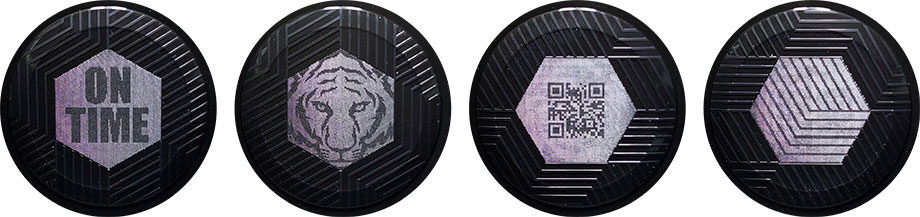
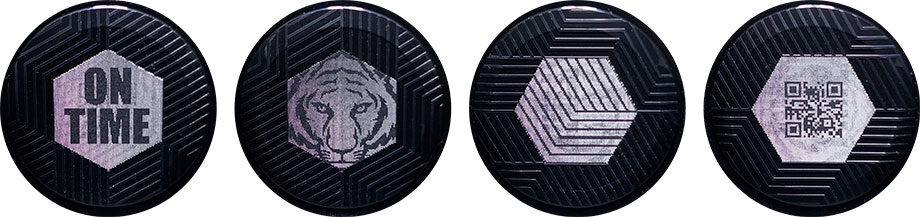
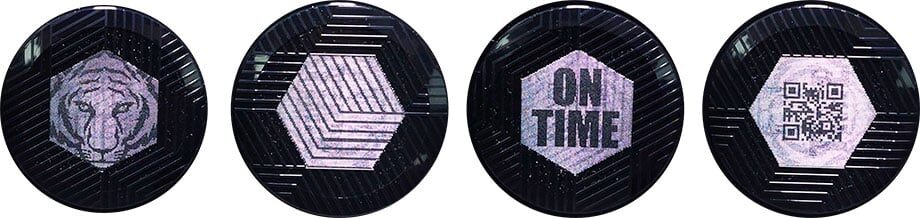
We took four photos of each sample, rotating the part every 90 degree.
5. Results
5.1 Black Materials
- PP – Excellent result.
Strong contrast, sharp definition, and very clear differentiation between the Microauthenfy images.
- ABS – Excellent result.
Strong contrast, sharp definition, and very clear differentiation between the Microauthenfy images.
- PC – Excellent result.
Strong contrast, sharp definition, and very clear differentiation between the Microauthenfy images.
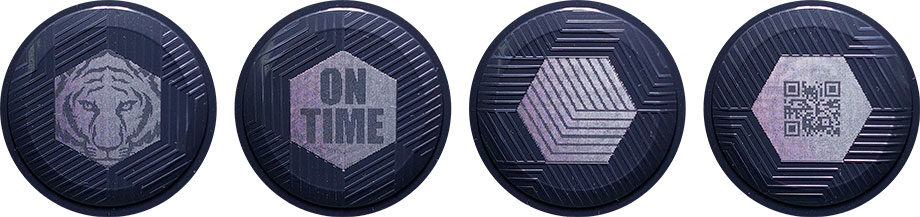
- RPP – Very good result.
Slightly lower intensity than virgin PP but still highly visible. All four images are clearly distinguishable—remarkable considering the variability typical of recycled materials.
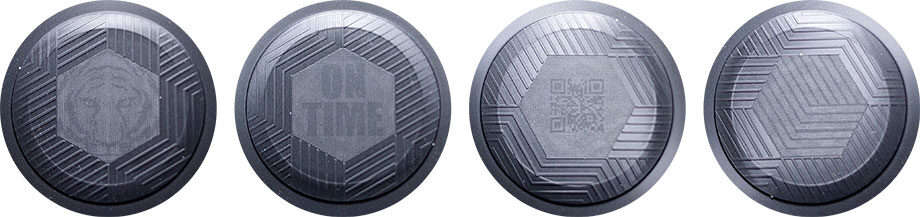
- TPE – Lower intensity.
The mark is visible, and the four images are distinguishable, but the softer material produces a less pronounced effect.
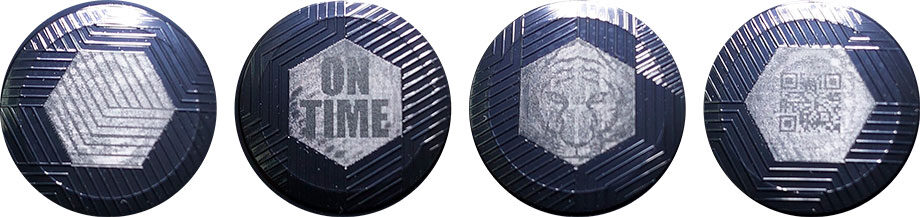
- HDPE – Lower definition.
Glossiness generates reflections, slightly masking the micro-optical effect. Some optical contamination is visible between images. Still functional but not as crisp as PP, PC or ABS.
5.2 Colored Materials
Polypropylene (PP)
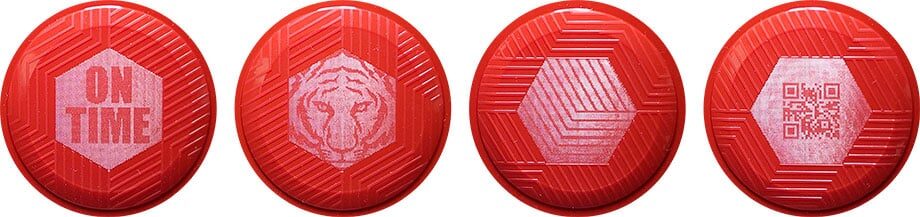
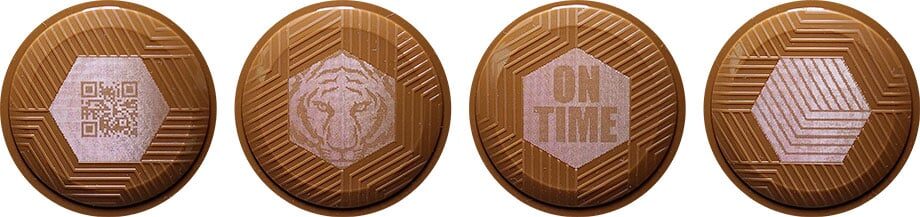
- Red – Excellent.
High contrast and strong readability.
- Brown – Excellent.
High contrast and strong readability.
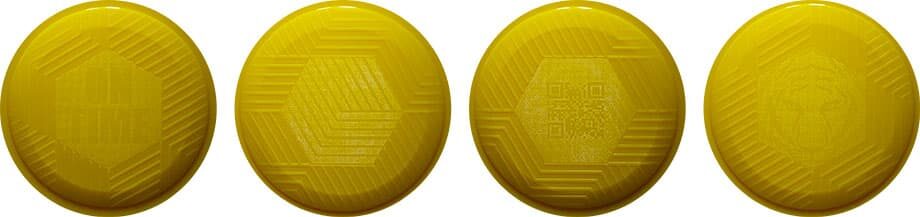
- Yellow – Moderate.
The effect is present but requires more attention to distinguish the images.
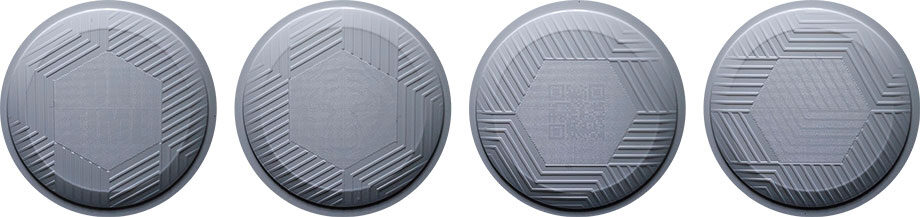
- White – Low contrast.
The mark is fully present but subtle. Differences between images are difficult to perceive without close inspection.
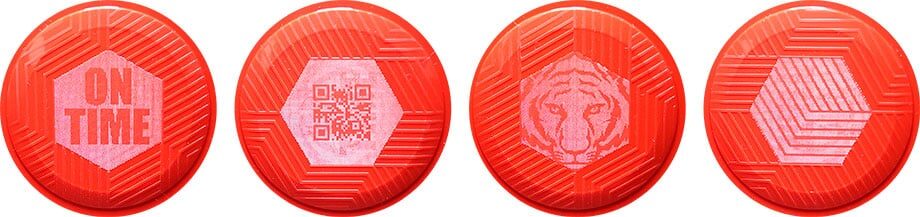
ABS
- Red – Excellent.
Strong, clean, and crisp.
- White – Good.
Better visibility than PP white. Even on white ABS, the four images are clearly distinguishable.
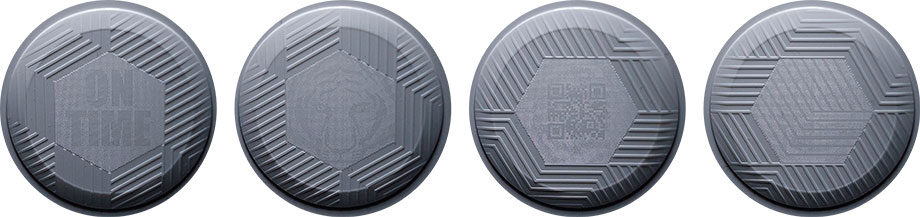
PC
- Transparent – Poor visibility.
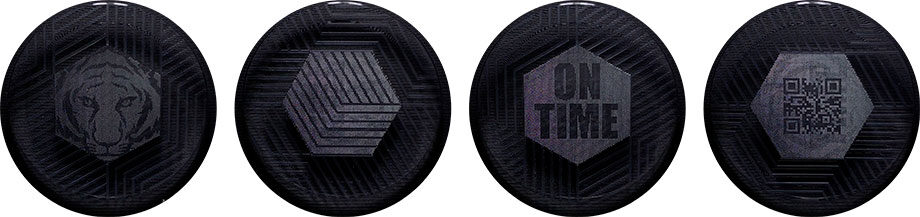
Visual contamination between images. Although the microstructure is physically present and fully replicated, the optical effect is not clearly visible to the naked eye. Strong internal reflections and high transparency allow light to pass through the microstructures rather than interact with it. On the other hand, very good effect with black background.
6. Conclusion
This study demonstrates that Microauthenfy performs reliably across the vast majority of injection-molded plastics and colors, reinforcing its suitability for packaging, footwear, consumer goods, and premium product categories.
Key conclusions:
- Dark and medium-tone colors consistently deliver excellent results.
- ABS, PP and PC provides outstanding replication, making it ideal for high-end, design-driven applications.
- Recycled materials (RPP) show strong performance, enabling sustainable products to carry secure authentication without compromise.
- TPE and HDPE still reproduce the mark, though with lower sharpness. More tests needs to be performed with these materials to ensure a better replication for a better Microauthenfy effect.
- Light colors (especially white and yellow) reduce visual intensity, but the Microauthenfy mark remains functional and detectable.
7. Performance after metallization
Many industries—particularly cosmetics, premium packaging, consumer electronics, automotive interiors, and wearable accessories—apply metallization to injection-molded parts for aesthetic, protective, or functional purposes. Because metallized surfaces reflect light differently than pigmented plastic, it was important to evaluate whether Microauthenfy® remains visible after this finishing step.
A subset of moulded samples was coated using standard metallization processes.
The result was excellent across all tested materials, exceeding expectations.

Metallization significantly enhanced the visibility of the Microauthenfy effect. The metallic layer creates high directional reflectivity, which amplifies the contrast between the micro-engraved zones. The optical behavior of the Microauthenfy images becomes more pronounced and sharper.
Overall conclusion:
Microauthenfy is robust, versatile, and suitable for the majority of injection-molded plastics and colors. When higher visual intensity is desired, darker colors and materials with higher replication fidelity (like ABS, PP or PC) offer the best results—but even in less favorable conditions, the authentication feature remains functional.


